
Supporting Young People Online:
Practical Steps for Families
One of the strongest drivers behind young people accessing social media is their very real need for human connection. Adolescents are biologically wired to seek belonging, interaction, and social affirmation. Social media platforms are designed to replicate connection through likes, comments, messaging, and constant updates. However, while these features mimic connection, they do not fully meet the human need for genuine, in-person interaction. In many cases, they can leave young people feeling less connected, not more.
This helps explain why some young people continue trying to access social media platforms, even after the government’s under-16 ban came into effect. Simply telling young people they cannot have social media, or assuming they will automatically make safe choices if they were to give up their social media accounts, may not always address the underlying need driving the behaviour. Peer pressure to remain connected is significant.
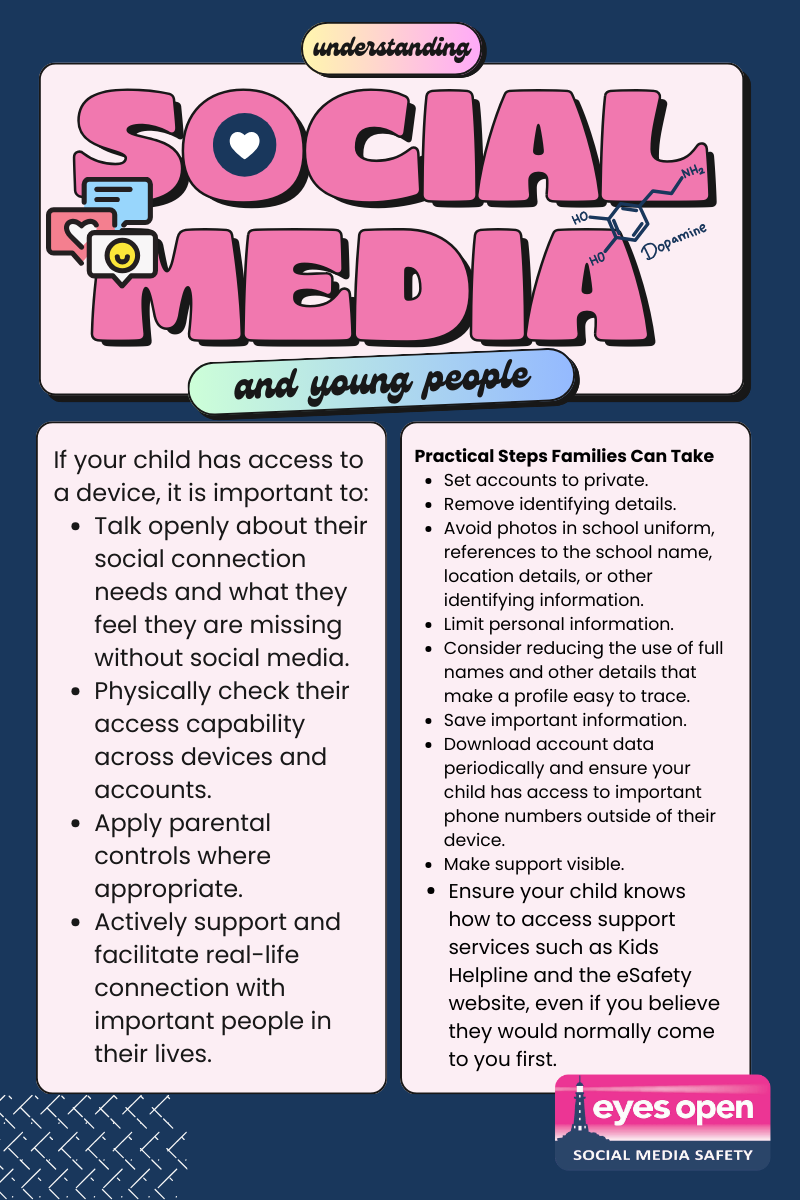
If your child has access to a device, it is important to:
-
-
Talk openly about their social connection needs and what they feel they are missing without social media.
-
Physically check their access capability across devices and accounts.
-
Apply parental controls where appropriate.
-
Actively support and facilitate real-life connection with important people in their lives.
-
Young people need both boundaries and support. Understanding the “why” behind their behaviour helps adults respond proactively rather than reactively.
Recent conversations with students have reinforced something equally important. When it comes to online safety, knowledge is powerful, but connection is protective.
Young people need to know where they can go for help if something feels uncomfortable, confusing, or unsafe online. That includes trusted adults at home and at school, as well as external support services such as Kids Helpline and the government’s eSafety website.
Even in families where children would normally speak openly with their parents, we are noticing that some young people feel unsure about how adults will respond, particularly while new social media laws are still being widely discussed. Children will find it particularly difficult to ask for help if their adults are not aware they are accessing social media platforms that the government has banned for under 16s. In those situations, fear of consequences can become an additional barrier to seeking support. Reinforcing that help will be calm, constructive, and focused on safety rather than punishment makes it far more likely that a child will ask for help early.
Understanding the Law as a Protective Boundary
Students are reminded in our sessions about the laws around people taking, sending, asking for, and storing intimate images of people under the age of eighteen. These laws exist to protect young people. When students understand that there are serious legal consequences attached to this behaviour, it provides them with a clear boundary they can rely on if they are pressured by others.
Understanding the law gives young people something solid to stand behind. “That’s against the law” can be a powerful and protective response.
Practical Steps Families Can Take
Regardless of individual family decisions about social media access, there are simple steps that significantly improve safety:
Set accounts to private.
This reduces visibility to strangers and limits unwanted contact.
Remove identifying details.
Avoid photos in school uniform, references to the school name, location details, or other identifying information.
Limit personal information.
Consider reducing the use of full names and other details that make a profile easy to trace.
Save important information.
Download account data periodically and ensure your child has access to important phone numbers outside of their device.
Make support visible.
Ensure your child knows how to access support services such as Kids Helpline and the eSafety website, even if you believe they would normally come to you first.
Conversation Starters for Home
Open, calm conversations remain one of the strongest protective factors for young people navigating the digital world. You may wish to ask:
-
-
What do you feel social media gives you that is important?
-
What did you learn about how social media platforms are designed?
-
Why do you think age restrictions are in place?
-
If something went wrong online, who could you speak to first?
-
What would make it easier for you to ask for help?
-
Do you know where to find support services such as Kids Helpline?
-
The goal is not to alarm or restrict, but to equip. When young people understand risks, know their boundaries, and feel confident that adults will respond with support rather than judgment, they are far more likely to seek help early.
I Was Blocked on Facebook. Guess Why?
Ever gone to send a message to a friend on Messenger and found that they aren’t listed as a contact? Or maybe you’ve looked up their Facebook page and their profile doesn’t show up? This happened to me a couple of months ago. After a few checks...
Is Your Phone Set Up For An Emergency?
In case of an emergency, Apple have created a place where you can add all of your critical information to be accessed by anyone trying to help you. The information can also be handy if you simply lose your mobile device. If you have...
Before you post a picture of someone else’s child…
People are becoming far more aware of the impact that social media posts can have not only for the people posting the content, but also the people who sometimes don’t choose to be a subject in the posts. Awareness campaigns are letting us all know that social media...
“Everything you’ve ever posted becomes public from tomorrow”
Every once in a while the "everything you've ever posted becomes public from tomorrow" post does the rounds on Facebook. In a panic, people copy and paste statements to their timeline, with the belief that they are somehow legally forcing Facebook to abide...
Child Minding & Social Media
It can be super difficult to have a conversation with the people minding your children after you discover that they’ve posted content involving your children on social media without your consent. …so here are a few things you should speak with people about before you...
Tumblr To Ban Adult Content
Super awesome news! Tumblr is FINALLY banning adult content. You may have noticed we have never posted about Tumblr on our page before. Nor do we discuss this site with children. We have always pointed out to parents to be aware of Tumblr though, during...